
Every band A to H for all six parts of Cheltenham in 2026/27, with band D at £2,356.15 in most of town and a £55.93 gap between areas. Checked September 2026.
Cheltenham’s council tax bands run from A to H, but the town does not have one council tax charge for each band. It has six sets, because five parishes inside the borough add their own precept on top. The difference between the cheapest and dearest part of town is £55.93 a year at band D, and where the boundary runs is not obvious from the street.
Most Cheltenham homes are in band C, and four in five are in bands A to D, the bands that qualify for the new £100 Household Energy Payment from January 2027. The count by band is further down.
Every figure below is for 2026/27 and was checked on 1 September 2026 against Cheltenham Borough Council’s published charges and the council tax resolution its councillors passed on 27 February 2026.
Every band, every part of Cheltenham
Most of the town is in the row marked “all other parts of Cheltenham”. If you live in Charlton Kings, Leckhampton, Warden Hill, Prestbury, Swindon Village or Up Hatherley, use your own row.
| Band | All other parts | Charlton Kings | Leckhampton with Warden Hill | Prestbury | Swindon Village | Up Hatherley |
|---|---|---|---|---|---|---|
| A | £1,570.76 | £1,608.05 | £1,597.25 | £1,595.44 | £1,583.65 | £1,580.55 |
| B | £1,832.57 | £1,876.07 | £1,863.47 | £1,861.36 | £1,847.60 | £1,844.00 |
| C | £2,094.36 | £2,144.08 | £2,129.68 | £2,127.27 | £2,111.54 | £2,107.42 |
| D | £2,356.15 | £2,412.08 | £2,395.88 | £2,393.17 | £2,375.48 | £2,370.84 |
| E | £2,879.73 | £2,948.09 | £2,928.29 | £2,924.98 | £2,903.36 | £2,897.68 |
| F | £3,403.33 | £3,484.12 | £3,460.72 | £3,456.80 | £3,431.25 | £3,424.55 |
| G | £3,926.91 | £4,020.13 | £3,993.13 | £3,988.61 | £3,959.13 | £3,951.39 |
| H | £4,712.30 | £4,824.16 | £4,791.76 | £4,786.34 | £4,750.96 | £4,741.68 |
Source: Cheltenham Borough Council, council tax bands, charges and appeals.
To the council’s credit, that table is on a plain web page rather than buried in a PDF, which is more than most districts manage. One naming quirk to watch: the parish is called Swindon Village in the charges table and simply Swindon in the council’s precept table and in the formal resolution. It is the same place.
What went up, and by how much
Band D across the borough rose by between 4.84 and 5.36 per cent, depending on which parish you are in:
| Part of Cheltenham | Band D 2025/26 | Band D 2026/27 | Change |
|---|---|---|---|
| All other parts | £2,246.52 | £2,356.15 | +£109.63, 4.88% |
| Charlton Kings | £2,298.06 | £2,412.08 | +£114.02, 4.96% |
| Leckhampton with Warden Hill | £2,273.91 | £2,395.88 | +£121.97, 5.36% |
| Prestbury | £2,282.75 | £2,393.17 | +£110.42, 4.84% |
| Swindon Village | £2,265.50 | £2,375.48 | +£109.98, 4.85% |
| Up Hatherley | £2,260.52 | £2,370.84 | +£110.32, 4.88% |
Three bodies take the money, and the borough gets a tenth
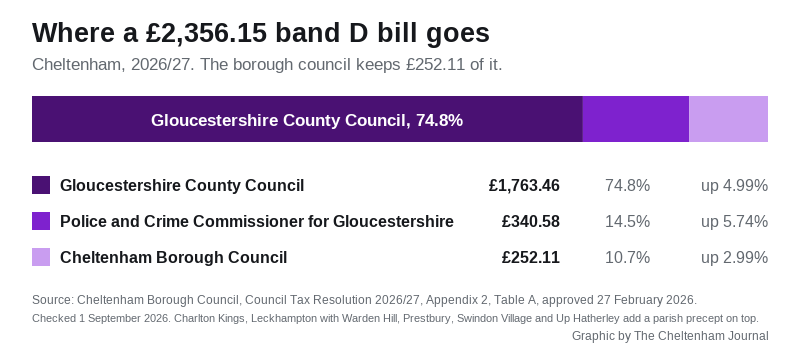
Of a £2,356.15 band D bill in the non-parish part of Cheltenham, the borough council keeps £252.11. That is 10.7 per cent. Everything else is collected on behalf of somebody else.
| Precepting body | Band D 2026/27 | Share | Increase |
|---|---|---|---|
| Gloucestershire County Council | £1,763.46 | 74.8% | 4.99% |
| Police and Crime Commissioner for Gloucestershire | £340.58 | 14.5% | 5.74% |
| Cheltenham Borough Council | £252.11 | 10.7% | 2.99% |
| Total | £2,356.15 |
The full band A to H figures for all three are in appendix 2 to the council tax resolution, approved by full council on 27 February 2026. That document also records the borough’s tax base for 2026/27 as 45,008.70 properties.
The county council’s rise is two rises stacked. Gloucestershire raised general council tax by 2.99 per cent and added a further 2 per cent adult social care precept, giving 4.99 per cent overall. Of the £1,763.46, £294.91 is the adult social care element and £1,468.55 is general county council tax. Councillors approved a £698.4 million budget on 18 February 2026, raising an extra £27.4 million. The council’s own summary of the effect is an additional £1.61 a week on a band D home (Gloucestershire County Council, 19 February 2026). Only 44 per cent of consultation respondents supported the increase.
The police precept rose fastest. It went up £18.50 at band D, from £322.08 to £340.58, a rise of 5.74 per cent, unanimously approved at a public meeting. The Police and Crime Commissioner’s gross budget for the year is £204.9 million, of which £100.2 million is police officers and £3.6 million PCSOs (Gloucestershire County Council and Police and Crime Commissioner leaflet 2026/27).
The borough took the smallest slice and the smallest rise. Councillors approved a net £19.24 million budget and a 2.99 per cent increase. That came with a £1.053 million savings programme, £159,334 of growth funding and a top-up of general fund balances to £1.5 million (Cheltenham Borough Council spending plans).
Leckhampton’s parish precept went up 45 per cent
The parish element is small in cash terms and volatile in percentage terms. Leckhampton with Warden Hill Parish Council raised its precept from £96,505 to £145,360 this year. Band D in the parish went from £27.39 to £39.73, a rise of 45.05 per cent (parish council tax charges).
| Parish | Tax base | Precept 2026/27 | Band D | Change |
|---|---|---|---|---|
| Charlton Kings | 5,086.00 | £284,461.00 | £55.93 | +8.52% |
| Leckhampton with Warden Hill | 3,658.90 | £145,360.00 | £39.73 | +45.05% |
| Prestbury | 3,237.70 | £119,865.00 | £37.02 | +2.18% |
| Swindon | 763.80 | £14,765.94 | £19.33 | +1.84% |
| Up Hatherley | 2,548.60 | £37,436.00 | £14.69 | +4.93% |
| Total | £601,887.94 |
Parish precepts are not capped by the referendum rules that hold the borough to 2.99 per cent, which is why a 45 per cent rise is possible. Across the five parishes the total went from £522,856.58 to £601,887.94, an increase of 15.1 per cent.
Any parish setting a precept above £140,000 has to publish a budget breakdown. Two now do: Charlton Kings and, for the first time this year, Leckhampton with Warden Hill. Both breakdowns are linked from the council’s parish charges page.
How many Cheltenham homes are in each council tax band
The Valuation Office Agency counts every home in the borough by band. On 31 March 2026 Cheltenham had 57,760 homes on the council tax list. Band C is the biggest single band, and Cheltenham has fewer band A homes than England as a whole but more in bands B and C.
| Band | Cheltenham homes | Share of Cheltenham | Share of England |
|---|---|---|---|
| A | 10,010 | 17.3% | 23.6% |
| B | 13,530 | 23.4% | 19.5% |
| C | 14,200 | 24.6% | 22.0% |
| D | 9,510 | 16.5% | 15.7% |
| E | 5,310 | 9.2% | 9.9% |
| F | 2,820 | 4.9% | 5.2% |
| G | 2,220 | 3.8% | 3.5% |
| H | 160 | 0.3% | 0.6% |
Source: Valuation Office Agency, Council Tax: stock of properties 2026, table CTSOP1.1. The VOA rounds each count to the nearest 10.
Bands A to D and the £100 energy payment. The Budget on 28 October brought in a £100 Household Energy Payment for households in bands A to D in England, paid from January 2027. If you pay by direct debit it is paid automatically; if not, the council will invite you to apply. Second homes and empty homes do not qualify (GOV.UK). In Cheltenham 47,250 homes, 81.8%, are in bands A to D, a touch above England’s 80.8%. Across Gloucestershire the share runs from 61.5% in Cotswold to 91.7% in Gloucester:
| District | Homes in bands A to D |
|---|---|
| Gloucester | 91.7% |
| Cheltenham | 81.8% |
| Forest of Dean | 80.5% |
| Stroud | 74.5% |
| Tewkesbury | 73.6% |
| Cotswold | 61.5% |
These are homes, not households, so the number of payments will not match exactly.
What is the most common council tax band in Cheltenham?
Band C: 14,200 of Cheltenham’s 57,760 homes, or 24.6%, were in band C on 31 March 2026, just ahead of band B (23.4%). Band C costs £2,094.36 in 2026/27 in most of the town.
How many Cheltenham homes are in band H?
160, about one home in 360. Band H costs £4,712.30 in most of Cheltenham in 2026/27.
Will I get the £100 Household Energy Payment in Cheltenham?
If your home is in bands A to D and it is your main home, yes, from January 2027. That covers 81.8% of Cheltenham homes. The full rules are still to be published.
What each council tax band means: the 1991 values
Council tax bands in Cheltenham are the same eight letters used across England, and each letter stands for a range of what the home would have sold for on 1 April 1991, not what it is worth now. The ranges are fixed in law by section 5 of the Local Government Finance Act 1992. Every band is a fixed fraction of band D, which is why the rows in the table above move in step:
| Band | 1991 value | Share of band D | Most of Cheltenham, 2026/27 |
|---|---|---|---|
| A | up to £40,000 | 6/9 | £1,570.76 |
| B | £40,001 to £52,000 | 7/9 | £1,832.57 |
| C | £52,001 to £68,000 | 8/9 | £2,094.36 |
| D | £68,001 to £88,000 | 9/9 | £2,356.15 |
| E | £88,001 to £120,000 | 11/9 | £2,879.73 |
| F | £120,001 to £160,000 | 13/9 | £3,403.33 |
| G | £160,001 to £320,000 | 15/9 | £3,926.91 |
| H | over £320,000 | 18/9 | £4,712.30 |
So a band H home pays exactly twice band D, and three times band A. A Regency townhouse and a modern flat on the same street can sit several bands apart, because the band follows the 1991 value of each individual home.
What council tax band is my house in Cheltenham?
Look it up by postcode on GOV.UK’s council tax band checker, which is run by the Valuation Office Agency. It shows the band for every home on the street, which is the quickest way to see whether yours looks out of line with similar neighbours.
How to check your band, and how to challenge it
Your band is set by the Valuation Office Agency, not the council, and it reflects what the property was worth on 1 April 1991. New homes are assessed as if they had existed then.
Find and challenge your band on GOV.UK. If you appeal the banding, you must keep paying the bill until it is decided.
Liability is a different appeal from banding, and it goes to the council first. You can appeal to Cheltenham Borough Council if you think you are not liable, that a discount or exemption should apply, or that your council tax support award is wrong. If the council does not respond or you still disagree, the next step is the Valuation Tribunal.
Discounts worth knowing about
The council calls the single person discount a sole occupancy discount. It is 25 per cent, the property must be your sole or main residence, and a temporary absence does not qualify. Tell the council straight away if another adult moves in (council tax discounts and exemptions).
Others that are easy to miss:
- Care leavers: a local discount runs until the 25th birthday, but only where the care leaver is the named liable person, and the council needs confirmation from the relevant authority first.
- Disabled band relief: if a permanently disabled adult or child lives there and the home has an extra room, an extra bathroom or kitchen, or space for indoor wheelchair use, the bill is charged at the band below. Band A homes get a partial reduction. Handrails, a stairlift or a ramp on their own do not qualify.
- Students: a home occupied entirely by full-time students is exempt. You need the exemption certificate from your institution, showing course start and end dates.
- Annexes: an annexe used by the main household, or lived in by a relative, qualifies for a discount. If that relative is over 65, severely mentally impaired or substantially and permanently disabled, it may be exempt entirely.
- Job-related second homes: a 50 per cent discount, but the tests are strict and there must be a direct link between the work and the property.
Empty homes get expensive fast
Cheltenham’s empty property ladder is one of the steeper ones, and the clock does not reset when a property changes hands (empty property and second homes premium charges):
| Time empty and unfurnished | What you pay |
|---|---|
| First six months | 75% of the charge (25% discount) |
| Six months to one year | 100% |
| One year to five years | 200% |
| Five to ten years | 300% |
| Over ten years | 400% |
Second homes, meaning furnished properties that are nobody’s main residence, carry a 100 per cent premium. Councillors agreed the premium regime at full council on 23 February 2024, and there is no right of appeal against the decision to levy it.
There are exceptions you have to apply for, with evidence. They cover armed forces accommodation, annexes, homes actively marketed for sale or let at a fair price for up to twelve months, properties within twelve months of probate, occupied caravan pitches and moorings, seasonal homes that cannot legally be lived in year round, and empty homes undergoing major repairs. Cheltenham separately gives a 25 per cent discount for up to twelve months on homes needing major structural work, which is not the same thing as a full refurbishment: replacing a seriously defective roof counts, replacing a dated but working kitchen does not.
The trap here is the six-month discount. It attaches to the property, not the owner. If the previous owner used four months of it, you get two.
Help if you cannot pay
Council tax support is means tested and takes account of your income, savings, pension, your partner’s income, children and any other adults in the household. Apply online, or call the benefits team on 01242 264341 (council tax support).
The evidence list is long, and the deadline is the part that catches people. All supporting evidence must reach the council within one calendar month of the application, or the application is treated as defective. The council aims to decide complete applications within 14 days. It does not publish the maximum percentage of a bill its scheme will cover, so we have not quoted one.
Who sends your bill after 2028 is now an open question
Cheltenham Borough Council was being abolished. On 16 July 2026 the government decided to replace Gloucestershire’s seven councils with a single unitary authority from 1 April 2028, to be called Gloucestershire Council with 110 councillors, down from the 295 who currently sit on the county and district councils (Cheltenham Borough Council, July 2026).
That is now on hold. On 7 September 2026 the Minister for Local Government wrote to council leaders asking them to cease work on implementing the July decisions while the government reviews the reorganisation programme. Elections scheduled for May 2027 will go ahead to existing council boundaries, rather than being replaced by elections to a new authority. No date has been set for the review reporting (MHCLG, 7 September 2026). Our full report is at Cheltenham council abolition paused.
Updated 30 October: ministers withdrew the July decision on 29 October and are now minded to create the single council in April 2029 instead, with elections in May 2028. Cheltenham Borough Council would set its share of the bill until then. Our report: Cheltenham council to go in 2029.
Cheltenham backed a two-unitary model and did not get it. For the table at the top of this page, the practical question was always what happens to the £252.11 district element. When councils merge, their council tax has to be brought to a common level, and the six Gloucestershire districts do not currently charge the same. Nobody had published how that would be done here, and now there may be no merger to do it for. The 2026/27 figures on this page are unaffected either way.
More Cheltenham local information: bin collection days, parking in Cheltenham, roadworks and travel, house prices, planning news.
Have your say